Points of Progress
This semi-regular report includes things happening in our world, policies, articles and practices in-line with the steady state economy or transitioning to it, that are worth some time to read about - the good news, the promising results. They are all exciting things happening I just don’t have time to post about each in-depth.
Here are some cool things happening in the world:
The 3/50 Project : Uniting Small Business With Local Citizen Action
In an effort to support local businesses and local economies and new campaign called the 3/50 Project asks you to pick your 3 favorite local businesses and donate $50 a month to each. From there website, “If have the employed population spent $50 in a locally owned business, it would generate more than $42.6 billion in revenue…. For every $100 spent in locally owned independent stores, $68 returns to the community.”
Even though the site’s founder is likely a growth-support , the concept is in-line with steady state economics: local economy is the core. If you want a more secure, just economy, starting local is the only way to go. Your money speaks louder than your words nowadays, so spend it wisely. It is simple campaigns like this one that inspire me to be hopeful, as the simple ones are usually more successful.
UK Post Bank Campaign
The campaign for a “post bank” in the UK isn’t exactly breaking news, but the progress and concept are noteworthy nonetheless. Just recently Ed Miliband , the British energy and climate secretary, put his support behind the post bank as well. To quote Miliband in the article , “It speaks to people’s sense of community – and frankly, banks have let down low-income consumers, and others as well. It is part of a new deal for the low paid around the banking industry.” (He isn’t the first to bank this idea, see here )
A post bank would be a public-owned bank run through the post office . It would be an readily available, community bank – allowing the people access to bank accounts without dealing with the fat-cat, big banks that dominate the landscape today. This institution would help small businesses, people of low incomes, and could restore public faith in the banking system (as well as create a banking system deserving of that trust).
Co-op profits surge as customers desert UK’s bigger banks
Right in line with the last bit, here is some news that points towards a more promising future: co-ops over big banks. Co-op groups reported a 38 percent increase in new accounts. Credit unions and co-ops internalize a lot of their risk, tend to lend more responsibly, and keep their profits in the community. In case you weren’t reading the above parts about how important the local economy and community really are, read my posts on the subject (“ The New Economy Starts Here ” & “ Local Currency & Bartering “)
So, news that the co-ops are seeing a profit serge as UK citizens leave the bigger banks is a good trend for two reasons: (1) hopefully this is a sign we have learned not to trust in the big, greed banks that caused our most recent “Great Recession,” and (2) we’re pushing towards a steady state economy with action – which speaks louder than, well, words.
Obama Announces Degrowth, Wins Republican Support

"We Must Forge A Sustainable Nation For All"
In a surprising turn of events, President Barack Obama announced in a press conference today that economic growth could no longer continue as we know it. As a prominent New York magazine quoted, “the press room went silent and after a tension-filled moment, erupted in applause!”
As numerous environmental groups , ecological economists , and have been trying for decades to gain political ground on the issue, a left-field bipartisan bill was drafted late last night and rushed through both the House and Senate. News of the conflict between growing the economy and maintaining an environment that can sustain human life was a shock to many in congress. However, conscience and prudence won the day, prompting late-night legislative sessions.
Tomorrow President Obama will sign into law the American Development and Reorientation Act, a comprehensive bill that will overhaul the financial sector , incorporate well-being into national accounts , end fossil fuel subsidies , tax pollution , cap greenhouse gas emissions , remove rights of person-hood from corporations , and provide minimum incomes and cap gaps in wealth – all to provide a more stable and just economic system that focuses on developing our society instead of expanding the size of our economy.
As the President said during the conference ,
“By recommitting ourselves to the founding ideals of this great nation, focusing on our possibilities and liberating ourselves from failed ideas and institutions, together we can create a stronger, better nation that secures a fulfilling life for every person and honors the premise of the Declaration of Independence that every individual is endowed with an unalienable right to life, liberty and the pursuit of happiness.”
This amazing turn-about in public policy not only represents the needs of the America people, but ensures a long, prosperous future for our society on this planet. This will go down in history as the first major (gigantic) step towards a sustainable world for all! Well done, Mr President!
**Happy April 1st everyone!**
Capitalism, Socialism and Communism
Let's Get a Few Things Straight Here
Okay, I am tired of these terms being used improperly. The last two are thrown around by politicos like they’re handing out free candy. Usually socialism is used by someone (we all know who) to label something they want to attack without using an actual argument or facts to support their opinion (also called bullshit).
Let’s quickly review the actual definitions of these three types of systems:
Capitalism : An economic system that allows private ownership of production. That’s it, that’s all capitalism actually entails – not low taxes, or private health care, or small government. Capitalism is simply a system that does not have government control of production (the government doesn’t own the factories, the companies – well, outside of car companies now – or the processes to produce products. Period). Capitalism refers to a type of economy, not a necessarily a type of government (“Social democracies” in Europe are still capitalistic countries, as the government does not control production).
Socialism : An economic system that advocates either public or direct worker ownership and administration of production and allocation of resources. Socialism removes production and wage labor as commodities, maximizing the “use value” instead of the “exchange value” – that is to say, real wealth versus phantom wealth. In a socialist economy the worker owns the production means and rights to resources.
Communism : An economic and social structure that advocates complete public ownership of production and allocation of resources. Communism is by far the most intertwined with political control of classes, wages, and policies to eliminate poverty or wealth gaps. Communism is considered more of a political expansion of the economic system of socialism and has been in the past portrayed as an attempt to create a Marxism utopia through government (ironic, as true Marxism would have no government).
Each of these systems has political ramifications in any society that institutes it. However, capitalism and socialism in-and-of themselves are economic systems. More importantly, none of these systems require economic growth . You can easily have privately owned production (flourishing production) without a continual expansion of the entire economy. Each of them are human creations. Economic growth is a human creation !
Any human system will be flawed, but hopefully we learn from our mistakes and get closer and closer to perfecting it. Perhaps this is humanity’s own Zeno paradox . While communism doesn’t work for us and socialism has its flaws, why should we assume that rampant capitalism is the answer? We should question the flaws in our system and work to correct them. A non-growth economy can be communist, socialist, capitalist, or anything else we want it to be – the economy is our creation.
Newsweek: The No-Growth Fantasy
Newsweek recently published an article titled, “ The No-Growth Fantasy: Europe’s Attack on Capitalism .” Calling a no-growth economy a fantasy is a bit delusional, I think continued economic growth is the real fantasy here. I just commented on that article, my response is below – expanded past their comment section’s character limit.
“A large part of what was taken as growth was financed by unsustainable bubbles in credit and asset prices.” Most of our growth in the past 50 years has been nothing but bubbles: credit bubbles, housing bubbles, internet bubbles, property bubbles – even a Uranium bubble. We all hate when the bubble pops, why get back on the growth horse and expect different?
You discuss resource depletion as if it can be thinned down to last forever, while we continue to grow the economy (and therefore, the amount of resources needed). Efficiency is key, for sure. However, you can only get so efficient ! If we could reach 100% efficiency we’d be able to use the same gallon of gasoline in our cars over and over again forever. Even if you don’t trust those pesky laws of thermodynamics , common sense should tell you this is pure nonsense.
And discussions of “barely tapped potential of genetic engineering and other plant-breeding technologies” envision a future of mutated plants, crowded cities, and soylent green. I don’t know about you, but I do not want to live in a world of genetically engineered food supplements, packed into a tight living space, simply because we didn’t want to think outside of economic growth. Besides, these technologies will have their limits as well, assuming we can make them viable in time, and then what? What’s the next thing we can latch onto in order to keep this hamster wheel spinning?
“Even if the critics are right and growth is going to be harder to attain post-crisis, that’s no reason to give up on it. Just the opposite: all the more reason to spend our energy coming up with the right policies—from education and innovation to entrepreneurship and competition—that will help foster it.” Right, pick something to keep the wheel going because you’re afraid to deal with the transition to a stable, just, sustainable economy? This is cowardice shrouded in a cloak of misplaced optimism.
One Family’s Commitment to a Better Economy
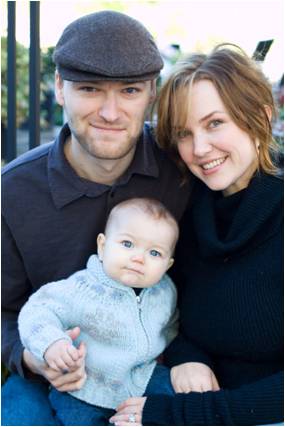
This appeared in my inbox this morning, from CASSE Executive Director Rob Dietz. I’m the first official monthly donor to CASSE, and I suggest you think about doing the same thing – for the price of a couple lattes a month you can help support the fight for a sustainable, socially just economy. What a great way to honor the one-year birthday of my son (yesterday)!

How about an economy built for the little guy?
How can we build an economy that supports our children? How about one that doesn’t undermine the earth’s natural systems? CASSE is one of the only organizations in the world tackling these questions head-on and providing hopeful and truthful answers, a fact that Josh Nelson appreciates.
Josh (pictured with his family) just became our first monthly donor online. He visited our website and arranged for his credit card to be billed $10 per month to help us promote a sustainable and fair economy. The most touching part about Josh’s gift is that he designated it in honor of his young son, a wonderful tip-of-the-hat to our role in safeguarding the well-being of future generations. If you want to see CASSE continue doing what we do, please follow Josh’s lead. Visit our online donation page and give a recurring donation that feels right to you. We consider all recurring contributors to be official CASSE members.
Donate now and join CASSE’s David vs. Goliath struggle against the powerful array of pro-growth fanatics. We need funding from citizens like you to keep this struggle alive.
Thank you,
Rob Dietz
Executive Director, CASSE
steadystate.org
The End of Growth

Richard Heinberg Says, "Growth Won't Continue."
Richard Heinberg , writer of Peak Everything and most recently Blackout , just wrote an article entitled, “ Life Without Growth .” While this is a long article, Richard provides a a potent analysis of our current economic standing, as well as where we are going in the future. Essentially, we’re all out of options that include continued economic growth – time to think about the next phase, a post growth society (hopefully a socially just steady state economy).
He does not mince words and says clearly that we’re “in for some hard times.” But he finds hope that we will use this challenge to eventually find an equilibrium. He goes on to say,
“The transitional period on our way toward a post-growth, equilibrium economy will prove to be the most challenging time any of us has ever lived through. Nevertheless, I am convinced that we can survive this collective journey, and that if we make sound choices as families and communities, life can actually be better for us in the decades ahead than it was during the heady days of seemingly endless economic expansion.”
Four Propositions to Life Without Growth
Heinberg gives us four propositions to not only understand our current situation, but also navigate our way to a desirable future:
- We have reached the end of economic growth as we have known it.
- The basic factors that will inevitably shape whatever replaces the growth economy are knowable.
- It is possible for economies to persist for centuries or millennia with no or minimal growth.
- Life in a non-growing economy can be fulfilling, interesting, and secure.
With these opening statements Heinberg goes on to advocate local economies, building stronger communities, and going forward with a mindset of action. “We must assume that a satisfactory, sustainable way of life is achievable in the absence of fossil fuels and conventional economic growth, and go about building it,” he says. I agree.
Social Business and Limits to Growth
Last night I attended a presentation by Dr Muhammad Yunus, Nobel Laureate for his pioneering work in micro-credit . Titled ‘ ’, the central messages in Dr Yunus’ presentation, to an enthusiastic and highly receptive Sydney crowd of more than 500, were simple. He believes access to credit is a human right; that we can end poverty by channelling the market forces of capitalism; and that we can ‘solve’ all the world’s problems if only private enterprise would be more widely accompanied by ‘ social business’ – a term he uses to describe commercial activity whereby businesses whose primary goal is to help ‘the poor’, reinvest their entire profits back into their work, rather than into shareholder pockets. Holistically speaking, I am not convinced.
Dr Yunus’ track record is as incredible as his ideals are worthy. His present-day work began in 1974 when he loaned US$27 to a Bangladeshi woman who made bamboo furniture. Viewed as a ‘repayment risk’, traditional banks were not interested in considering such individuals for the provision of small loans. This experience was to prove life-changing for Dr Yunus.
Nine years later he established the Grameen Bank that has since disbursed US$6.6 billion in micro-loans averaging US$130 to ‘the poor’. Bypassing the traditional method of a customer needing to demonstrate collateral before a loan can be administered, the Grameen bank uses a customised approach to solidarity lending whereby each drawer must be in a five-person group that merely serves to encourage repayment. The results have been stunning. The bank boasts a repayment rate of 98.35 per cent and 97 per cent of its members are women . As Dr Yunus noted with a smile in his Sydney presentation, the global financial crisis showed who you can really bank on when it comes to repayments.
The Grameen model has now been replicated in over 100 countries, with proposals on the table for its extension to poverty-stricken cities in the ‘developed world’ such as Glasgow, in the U.K .
There is no doubting that Dr Yunus’ approach continues to challenge attitudes of business in both the ‘developed’ and ‘developing’ world. But does it challenge these views enough to ensure our longer-term sustainability as a species? Thinking ahead, perhaps Dr Yunus’ approach sets us up to hit a fundamental ceiling in which inequity-creating businesses continue to thrive, removing hope for ‘poverty alleviation’ and sustainable futures, because their image in the community is largely defined by publicly-embraced subsidiary social businesses.
Unfortunately, Dr Yunus’ presentation reinforced my frustration with what I see as ultimately atomistic arguments made by our ‘poverty champions’ (think Jeffrey Sachs , Bono , Hugh Evans ). Thus, when the floor opened up to questions I asked:
“In a world with serious biophysical limits, how can any growth-based financial system – including micro-credit – ever be truly sustainable?”
Dr Yunus quickly replied that human creativity is an amazing thing and that I should not be so grim.
I sat down. Given the chance, I would have responded by saying that his answer is the kind men have been giving ever since anthropogenic global warming became accepted by mainstream audiences and the news on this front is not getting any better. At its heart, I believe Dr Yunus’ answer falls somewhat into the common habit of using the term ‘creativity’ as a pseudonym for ‘technological innovation’. In this sense, there is mounting evidence that such faith is misplaced; that the idea of de-coupling economic growth from environmental degradation at the speed required to avoid catastrophic effects from climate change is totally unrealistic. In addition to , as Professor Tim Jackson from the University of Surrey in the U.K. has :
“In a world of 9 billion people, all aspiring to a level of income commensurate with 2% growth on the average European Union income today, carbon intensities (e.g.) would have to fall, on average, by more than 11% per year to stabilize the climate, 16 times faster than they have fallen since 1990. By 2050, the global carbon intensity would need to be only 6 grams per dollar of output, almost 130 times lower than it is today…”
All said and done, I remain critically hopeful. I think Dr Yunus is inspiring and well-intentioned, and I like his concept of social business – similar to what we, in Australia, call not-for-profit social entrepreneurship . In fact, I like his concept so much that I propose we be brave enough to entertain the thought of a world in which every business is a social business.
From large multinationals to small cafes, what could we create if the ‘developed world’ unhooked itself from its addiction to quantitative growth and the ‘developing world’ was free from ideological and physical coercion to adopt unsustainable ‘development models’? As Dr Yunus is quick to note, when you take the individual profit motive out of it, anything becomes truly possible.
Guest contributor Donnie Maclurcan runs an Australian social business , is investigating nanotechnology and its consequences for global inequity and is working on a film about the limits to growth .
Thoughts on Money, Wealth and Value
I might be amongst a rare few who believe that the real worth of a person is based outside of material possessions and economic status. Perhaps our society is right to place value in material wealth and pull away from centuries of teachings valuing integrity, ethics, and community (see valuing what matters ). There is strong argument that this skewed approach to valuing material wealth is, in part, why our generation is suffering from a rising “social recession.” What we value, how we value, and where we place the concept of wealth are drastically important parts of our lives and our society.
The chemist turned rogue economist Frederick Soddy was one of the first to lay out the difference of real wealth and, what he termed, “virtual wealth.” Today, “real wealth” is a term being used by the to represent physical wealth in the real world. “Phantom wealth” (or Soddy’s “virtual wealth”) is the monetary representation, or store, of real wealth. It is being described as phantom because we have inflated our system to allow money to make more money – money out of thin air is virtual, phantom wealth. But isn’t that money is a store for real, physical value?!
So if we create new money, either by printing it, loaning it into existence , speculative trading, or some other devilish creation of the private banking system, do we also create correlating real wealth? No. This means as we allow money to earn more money, without ever being traded for a real, valuable good or service , we are devaluing those real goods. Banks are essentially stealing real wealth by creating more phantom wealth for themselves. (All the more reason for a Robin Hood Tax )
I just picked up one of Soddy’s books that outlines these concepts: Wealth, Virtual Wealth, and Debt . Soddy set a lot of the ground work for today’s ecological economists and his work was greatly expanded upon by Herman Daly , Richard Douthwaite and Nicolas Georgescu-Roegen . I am excited to read some of Soddy’s work and in researching his (spot-on) views of money, debt, and the banking system I found more great quotes on the subject I wanted to share.


 Start a Revolution!